

College audiences move fast. Ads fade. Flyers flop. But communities stick. That’s why online community engagement has become the core of modern college marketing—and a blueprint any brand can use.
Below, you’ll see how campus tactics translate into scalable programs, how to time your prompts, and how to connect retail trials to D2C loyalty. You’ll also get a 30-day plan and snippet-ready FAQs.
What Is Online Community Engagement (and Why It Converts)?
Online community engagement is not “likes.” It’s repeatable actions that move people toward value:
- posting UGC,
- completing challenges,
- uploading proof-of-action (e.g., a receipt),
- redeeming rewards,
- referring friends.
Short answer: it’s behavior you can measure and scale. And when you measure it, you can grow it.
Why Does the Flywheel Matter?
To begin with, online community engagement means more than likes or comments. It refers to the actions people take that move them deeper into a brand relationship. For example, when members share user-generated content, join challenges, refer friends, or upload proof-of-purchase, they are not only participating but also creating momentum.
Moreover, these actions build on each other. One referral leads to another. One post sparks ten replies. One challenge motivates the next. This is why online community engagement works like a flywheel.
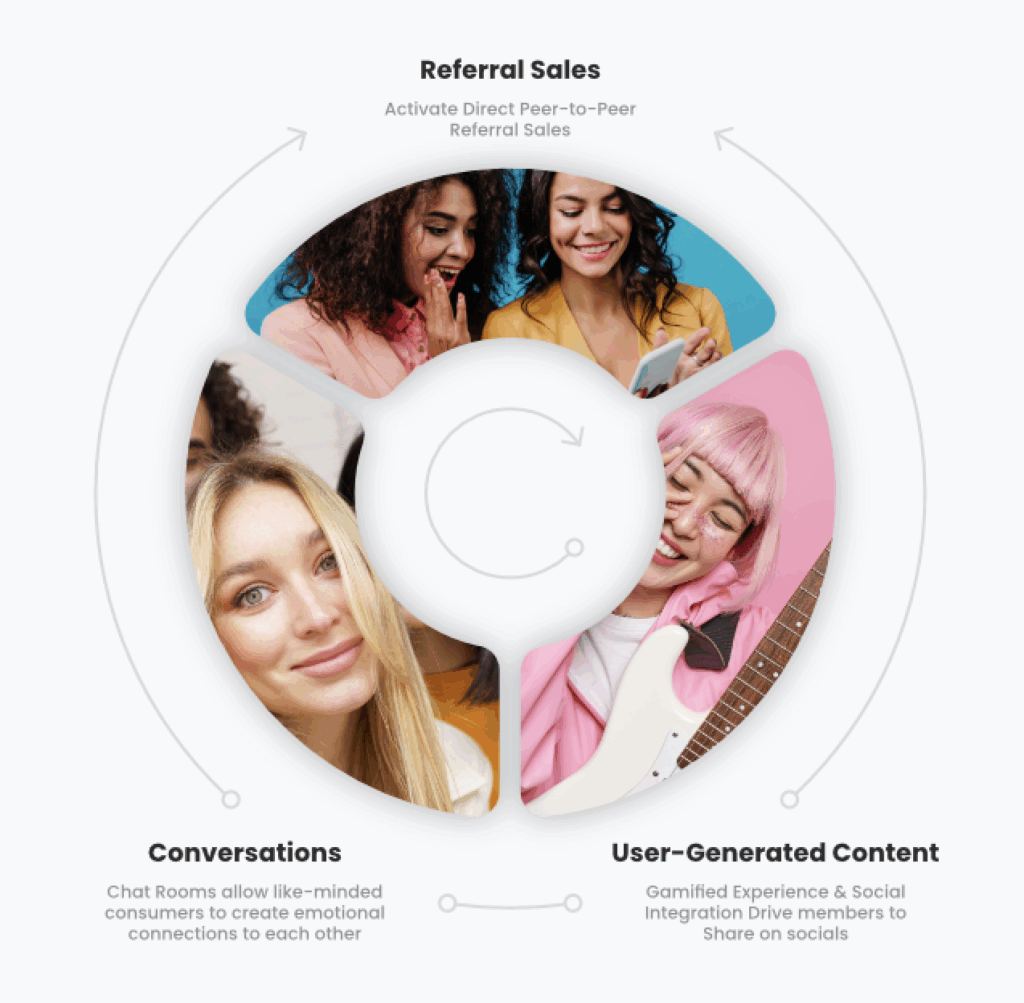
A flywheel is different from a funnel. While a funnel ends after conversion, the flywheel keeps spinning. As a result, engagement fuels acquisition, and acquisition fuels retention. Consequently, the more energy you add, the faster growth compounds.
In addition, a strong flywheel reduces your dependence on paid media. Instead of starting from zero every campaign, you can rely on your community to amplify messages, create urgency, and spread authentic recommendations. Therefore, every action inside the community not only delivers short-term results but also adds force to the long-term growth engine.
Finally, this matters for brands today because attention is fragmented. Paid ads are expensive and short-lived. However, community engagement online gives you durable momentum. For instance, when students join a weekly challenge, their activity does not disappear—it compounds. In other words, the flywheel ensures that your community is not a cost center but a continuous driver of growth.
Online Community Engagement in College Marketing: The Fit
Students want belonging. They also spot inauthenticity fast. Community fixes that gap.
- Build spaces where students participate, not just watch.
- Blend on-campus activations with community engagement online (challenges, referrals, early access).
- Reward proof, not just impressions.
In other words, community turns a one-day campus splash into a month-long movement.
What Top Campus Campaigns Have in Common
Brands across categories—furniture, beverage, mobility—win students with shared patterns:
- Experience first. Pop-ups and dorm makeovers spark content; online community engagement sustains it.
- Peer-to-peer loops. Sampling → UGC → amplification → FOMO.
- Utility + culture. Discounts and group features become rituals, not gimmicks.
You don’t need a stadium event. You need a community engine behind any event you run.
Pillars of Online Community Engagement (College or Not)
Use these five pillars; they compound:
- Purpose — “I’m here to ___.” Make the “why” obvious.
- Participation — Start with small, easy tasks.
- Progress — Tiers, streaks, and leaderboards create momentum.
- Perks — Mix cash-equivalent benefits with status and access.
- Proof — Spotlight member results; peers follow peers.
Tip: Put each pillar into a weekly rhythm (next section).
Timing Matters: When Online Community Engagement Peaks
Across adult communities, a consistent pattern shows up:
- Mon–Tue: highest activity
- Wed–Thu: solid mid-week energy
- Fri–Sun: engagement dips
Plan around it:
- Launch on Monday.
- Drop a mid-week booster (2× points).
- Keep weekends light: polls, “streak saver” prompts, quick check-ins.
Programs That Drive Online Community Engagement
Tiered Challenges (Progress That Feels Doable)
- Set achievable rungs: 1, 3, 5, 10 actions.
- Announce unlocks publicly.
- Send “you’re one away” nudges.
Why it works: visible progress fuels effort.
Proof-of-Action Flows (Retail → D2C)
- Members upload a campus receipt or photo.
- Unlock an instant D2C voucher or points.
- Limit the window (e.g., 48 hours) to add urgency.
Why it works: trials at retail become owned relationships online.
Social-Proof Loops (Students Lead the Story)
- Prompt UGC: “Show your setup,” “Post your haul,” “Record your routine.”
- Repost students; give credit in-community.
- Reward the behavior you want to spread.
Why it works: students trust students.
Time-Bound Sprints (10–14 Days)
- Anchor to a campus moment (move-in, midterms, rivalry week).
- Keep rules stable; push a countdown.
- Close hard with last-48-hour reminders.
Why it works: focus beats fatigue.
A 30-Day Plan to Launch Online Community Engagement
First, Week 0 — Prep (3–5 Days)
- Pick two plays: tiered challenge + proof-of-action.
- Define rewards students actually want (cash + perks + access).
- Write prompts and nudges in advance.
- Set up leaderboard and progress bars.
- Approve T&Cs and dates.
Week 1 — Launch (Start Monday)
- Announce in email, SMS, and community.
- Seed creator posts with ready-to-share assets.
- Ask for small actions first (polls, selfies, tags).
- End the week with a UGC roundup.
Week 2 — Boost
- Run a 2× points day.
- Share standings.
- DM your top 20% with stretch goals + caption templates.
Finally, Week 3 — Close & Convert
- Fire last-48h nudges.
- Deliver rewards instantly.
- Open early access on D2C for participants.
- Recap wins and invite the next micro-challenge.
Result: repeatable online community engagement you can scale beyond campus.
Mistakes That Stall Online Community Engagement
- No purpose: if students can’t say why they’re here, they won’t stay.
- Discussion-only: talking without tasks leads to drop-off.
- Moving goalposts: changing rules mid-sprint kills trust.
- Brand-only voice: let students lead the story.
- Forever campaigns: sprints beat marathons.
Fix one issue per week. Momentum comes back fast.
Measurement That Matters (Not Just Likes)
Track a handful, weekly:
- Activation rate: % who completed ≥1 action.
- Completion velocity: time from join → first action.
- UGC volume: posts created, not likes.
- Conversion bridge: engagement → trial/order/referral.
- Voucher redemption: retail-to-D2C loop working?
- Return rate: acted last week and this week?
Share one slide: what shipped, what moved, what’s next.
Copy Prompts That Lift Online Community Engagement
- “Show your setup. Tag a friend who needs this.”
- “Today only: 2× points for first-time posters.”
- “You’re one step from the next tier—post your progress.”
- “Upload proof to unlock early access.”
- “Last 48 hours. Save your streak.”
Keep the ask tiny, the reward near and the tone human.
From Campus to Company—Why This Scales
College marketing is a culture lab. What works there usually works everywhere. The same online community engagement mechanics—proof, progress, and perks—turn casual fans into loyal buyers in any vertical.
So, don’t rent attention with one-off events. Own the relationship with programs that members choose to join, weekly.
FAQs
What is online community engagement?
It’s a set of measurable actions—UGC, challenges, referrals, proof-of-action—that moves members toward outcomes you care about.
How do I increase community engagement online fast?
Run a 10–14 day sprint. Launch Monday, add a mid-week 2× boost, and close with last-48-hour reminders. Tie actions to instant rewards.
Which formats convert best for students?
Tiered challenges, proof-of-action flows (receipt → voucher), social-proof loops, and time-bound sprints.
How do I connect retail to my D2C channel?
Ask members to upload a retail receipt; issue an instant D2C voucher or points; follow with early access online.
What should I measure weekly?
Activation rate, completion velocity, UGC volume, conversion bridge, voucher redemption, and return rate.
You already have the audience. Now, turn attention into action. Launch one sprint. Prove lift in 30 days. Then scale what worked.
👉 Read the full playbook and see examples.
👉 Book a strategy call to tailor online community engagement for your next campus moment.

How Community-Driven Campaigns Can Power your Holiday Sales Strategy

Why Ambassador Engagement Spikes Early in the Week—And How to Build on It

No Comments Yet
Let us know what you think